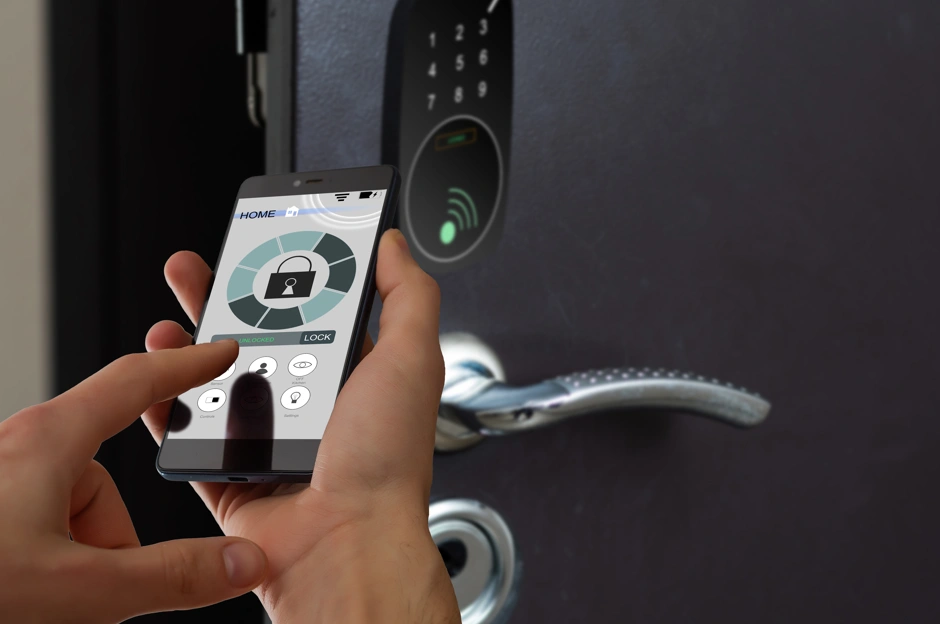
You tap your phone, the door unlocks, and it feels like the future arrived at your front step. Then a quieter thought creeps in. If a phone can open the door, can a stranger with the right skills do the same? Smart locks bring real convenience, yet the security question is fair and worth a straight answer. A well-chosen lock backed by a proper smart lock installation can hold up as well as a good deadbolt, while a cheap one can leave your home wide open. Here is how they actually stand up.
How Modern Smart Locks Keep Your Door Connected?
A smart lock is an electronic door lock that opens without a metal key. Instead of a cylinder you turn, it uses a keypad code, a phone app, a fingerprint, or a small wireless signal to slide the bolt. Most home models still sit on a standard deadbolt, so the metal bolt going into the frame is the same. What changes is how you tell that bolt to move.
These locks talk to you and to your phone in a few ways, and each one carries its own strengths:
- Keypad entry uses a PIN code, so nobody carries a key that can be lost or copied.
- Bluetooth unlocks when your phone is close, which works without internet but only at short range.
- Wi-Fi connects the lock to your home network, so you can lock or check the door from anywhere.
- Fingerprint or biometric reads a trait that is hard to fake, opening the door with a touch.
The keyless part is what people love. You give the dog walker a temporary code, watch the door open on your phone, and never hunt for keys in the rain again. That same connection to a network is also where the security question begins.
Also Read: Smart Locks vs Traditional Locks
How to Protect Against Smart Lock Vulnerabilities?
Here is the honest part. A smart lock adds a second front door, a digital one, on top of the physical one. A regular lock only worries about picking and force. A smart lock also has to guard the app, the network, and the code. Weak spots show up in a few places.
The clearest warning comes from the government itself. The Federal Trade Commission took action against smart lock maker Tapplock, whose padlocks were sold as “unbreakable.” In the FTC’s own account of the case, a researcher opened one of the locks within seconds by unscrewing the back panel, and because the company did not encrypt the data between the lock and the app, researchers could generate the keys to lock and unlock any nearby unit. A third flaw meant a user could not fully revoke access once they had shared it. One weak product failed on the physical side, the digital side, and the access side all at once.
The common attack points on a home smart lock look like this:
- Weak or reused PIN codes, like 1234 or your street number, that a burglar guesses fast
- Unencrypted Bluetooth or Wi-Fi that lets someone nearby capture the signal
- Outdated firmware and apps with holes the maker already fixed, but you never installed
- Physical tampering, where a thief pries or unscrews a cheap unit off the door
- App and cloud breaches, since your code and location may sit on a company server
The Pros and Cons of Smart Lock Security
The truthful answer is that it depends on the lock and the person using it. A quality smart lock can beat a basic key lock on several fronts, while a bargain model can be worse than the cheap knob it replaced.
On the plus side, a smart lock removes the risks a traditional key carries. There is no key to copy at a hardware store, no spare hidden under the mat for a burglar to find, and no lock to pick in the usual way. You also gain eyes on the door. The lock tells you when it opens, lets you give each person their own code, and lets you shut off a code the moment a cleaner or an ex-roommate should no longer get in. No metal key can do that.
On the minus side, a smart lock depends on batteries, software, and a network, and each of those can fail or be attacked. A dead battery or a crashed app can leave you standing outside your own home, which is one more reason to keep a mechanical key backup and the number of a 24-hour locksmith handy. The lock is only as strong as the deadbolt and door behind it too, so a smart lock on a hollow door still gives way to a hard kick.
How to Strengthen Your Smart Lock Protection?
A smart lock protects your home when the product is solid and the setup is done with care. Most break-ins that involve these locks trace back to a weak code, skipped updates, or a cheap unit, and all three are avoidable.
Choose the Right Lock
Buy from a maker with a track record of fixing flaws fast, and look for real security features rather than marketing words. Strong encryption, two-factor login for the app, an ANSI Grade 1 or Grade 2 deadbolt rating, and tamper alerts are the marks of a lock worth trusting. A lock that stores fingerprints on the device itself, not in the cloud, protects data that you can never change once it leaks.
Lock Down the Setup
The best hardware still fails with lazy settings. A few habits close most of the gaps:
- Set a long, random PIN and give each family member and guest their own code.
- Turn on two-factor authentication for the lock’s app.
- Keep the lock’s firmware, the app, and your phone updated.
- Secure your home Wi-Fi with a strong password and WPA3 encryption.
- Use temporary, expiring codes for guests, contractors, and deliveries.
Pairing the lock with the rest of your home security, like a camera at the door and a solid frame, turns a single device into a layer of real protection. This is also where a trained hand matters. A professional checks that the deadbolt seats fully, that the door and strike can take force, and that the electronic side is set up right, so you are not left guessing.
The Right Smart Lock Makes All the Difference
A smart lock is a smart choice when it is the right lock, installed and set up the right way. It becomes a weak point when it is a cheap unit with a lazy code on a flimsy door, and by the time you learn the difference, someone may already be inside. You can settle this before it is tested, and it costs far less than the break-in it prevents.
At Payless Locksmith, we install, program, and secure smart locks and digital door locks for homes across Washington, DC, and if a battery dies or an app locks you out, our emergency locksmith team answers around the clock. As a licensed and insured team with over 15 years in the field, we match the lock to your door, set the encryption and codes correctly, and make sure the deadbolt behind the tech can hold its own. When you want keyless convenience without giving up safety, reach out to our team for honest advice and a setup built around your home.